
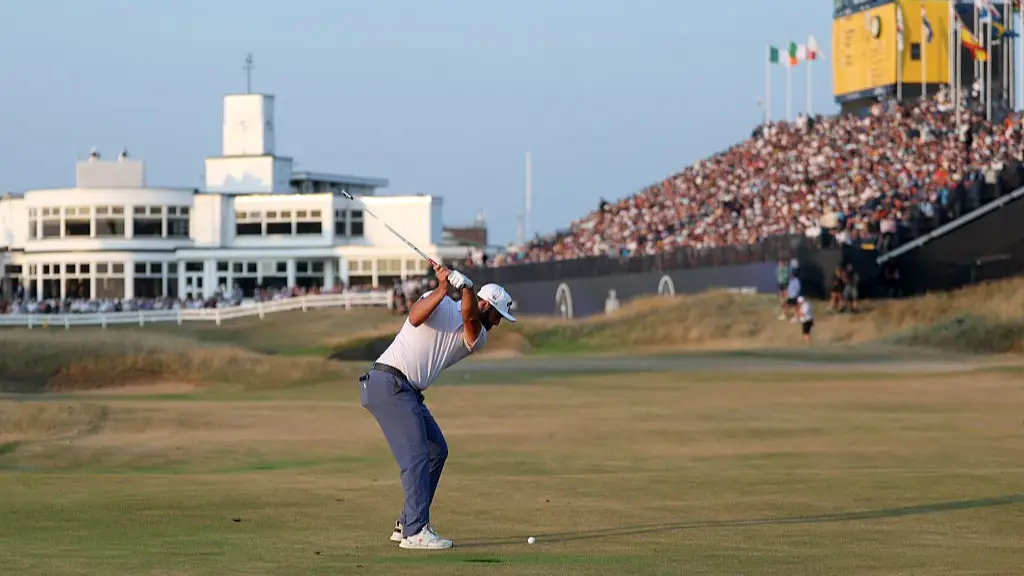
The Open star gave a friendly reminder about good behavior after the Bryson DeChambeau controversy.
Another top player has been warned after Bryson DeChambeau got a two-shot penalty on day two of The Open.
Even though he disagreed, DeChambeau was penalized for breaking Rule 8.1, which says players must play the course “as you find it.” This rule limits what players can do to change conditions that affect their shots.
After a tense talk with officials, DeChambeau was given the penalty because he stepped on long grass near his ball on the fifth hole. There were rumors he might quit the tournament, but on Friday (July 17), he posted on social media: “Obviously disappointed with the ruling. I don’t agree with it, but it is what it is. This fires me up. Onto the weekend. Let’s get it.”
Grant Moir, the R&A’s executive director of governance, explained the rule: “Rule 8.1 stops a player from changing any conditions affecting their shot, including the area where they swing. This means altering anything to gain an advantage, even if it happens by accident, like in Bryson’s case.”
At the same time, Jon Rahm had a tough moment during the second round at Royal Birkdale. After missing the green on the par-3 15th hole while three under the tournament, Rahm angrily threw his iron into the tee box. The club bounced off the ground, and he ended up with a bogey.
Rahm said, “It was just a bad shot. The tee shot was perfect with the wind, right distance for a 6-iron, aiming at the left bunker, and I just completely missed it.”
Officials talked to Rahm on the 17th tee and gave him a warning for his behavior on the 15th. He didn’t get a penalty, even though other players have received two-shot penalties for similar actions before.
Rahm said, “I wasn’t thinking about the warning. If I tried to change who I am too much, it might hurt my game. But I definitely shouldn’t have acted like I did on 15; I get it.”
Before The Open, the R&A shared their rules on “serious misconduct” with Golfweek: “If a player or their caddie acts in a way that goes against the spirit of golf, the Chief Referee and Chief Championships Officer can give an official warning, a two-stroke penalty, or even disqualify the player. They consider how often it happens, how serious it is, and the player’s intent. Sometimes a warning isn’t needed before applying penalties.”