
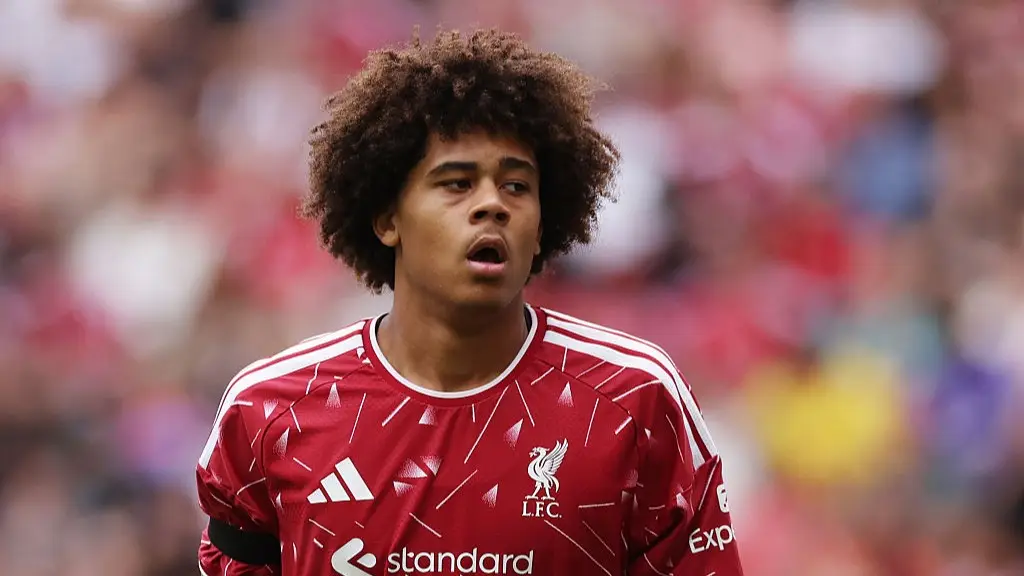
How Liverpool’s new young star can still play for the club this season despite a rule that makes him go on loan
Liverpool fans were excited to see 18-year-old defender Ifeanyi Ndukwe play well in the Reds’ 3-2 loss to AS Monaco. But they were disappointed to learn that the Austrian can’t yet play in official matches for the club. Luckily, there might be a way around this.
Sunday (August 9) was Andoni Iraola’s first time managing Liverpool at Anfield. Early goals from Alexander Isak and Florian Wirtz gave Liverpool a strong start. But just before halftime, Alexander Golovin scored a penalty for Monaco. Later, Mika Biereth and Paris Brunner helped their team take the win, ending the game 3-2 and leaving the Liverpool fans puzzled.
Despite the loss, Iraola saw bright spots, especially with young players Lewis Koumas and Ndukwe standing out. Ndukwe played the first half looking calm and confident before being substituted at halftime by Wataru Endo.
Ndukwe is very tall (six feet six inches) and joined Liverpool from Austria Wien in January for £2.6 million. Unfortunately, he can only play one more match for Liverpool this season—a friendly against Como on Sunday (August 16). This is because he didn’t meet the points needed for a UK work permit.
In the past, Ndukwe might have filled an Elite Significant Contribution (ESC) spot, which helps players qualify through a special exemption. But new rules mean players now have to meet criteria based on how many games they’ve played for their national teams, both senior and youth levels, plus other factors.
Liam Henshaw, a data analyst and scout, explained how it works: “When clubs sign overseas players, those players need permission to work in the UK. The Football Association issues a Governing Body Endorsement (GBE) if the player meets the standards, and this helps the club get a work permit from the Home Office through a points system.”
Players automatically qualify if they regularly play for a strong national team. Henshaw said, “It depends on how many competitive games they’ve played compared to their nation’s FIFA ranking. Top players for top-ranked countries pass easily. Fringe players for lower-ranked countries usually don’t.”
If a player doesn’t get automatic approval, they need at least 15 points based on things like league minutes, international games, league finish, and continental play. “If they score between 10 and 14 points, clubs can ask an independent panel to make a case. Below 10 points usually means no permission for that transfer window,” Henshaw added.
For Ndukwe to qualify, it might be best for him to go on loan to a Band 1 or Band 2 league. Playing there could help him earn the points needed for the FA’s approval and a work visa for Liverpool.
Band 1 leagues include the Premier League, Bundesliga, La Liga, Serie A, and Ligue 1. Band 2 covers leagues like Portugal’s Primeira Liga, the Eredivisie (Netherlands), Belgian First Division, Brazil’s Serie A, and the English Championship.
Henshaw pointed out, “The biggest factor is minutes played in the domestic league. Playing almost all available game time in a Band 1 league scores 12 points. Band 2 leagues give 10 points for the same. The points decrease the fewer minutes you play and the lower the league’s band.”
Unfortunately for Ndukwe, Mor Talla Nidaye has taken the last ESC spot available. This likely means Ndukwe won’t be able to play competitively for Liverpool until at least 2027.