
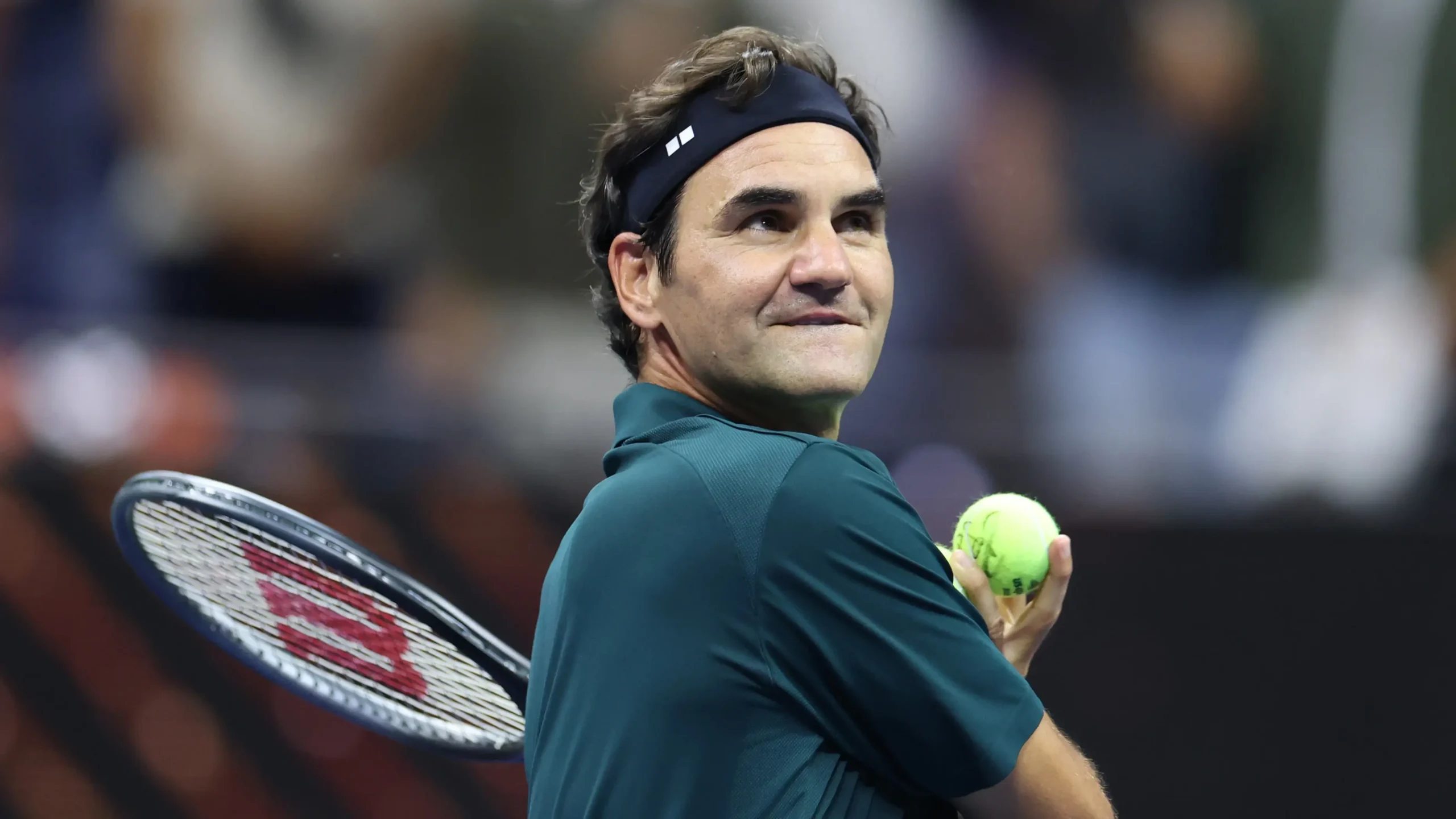
Roger Federer talks about why a beloved tennis move is disappearing as he gets ready for a possible historic moment at the US Open.
Roger Federer recently talked about why the one-handed backhand, a shot he was famous for during his career, is becoming rare—just before the US Open, where history might be made. The 45-year-old answered questions at a press conference as he returned to the US Open and played a fun exhibition match against his old rival, Andy Roddick, the night before.
Federer and Roddick had many memorable matches, including the famous 2009 Wimbledon final, which Federer won 16-14 in the fifth set. Roddick won his only Grand Slam at the 2003 US Open before Federer’s era of dominance began. Roddick was often seen as the unlucky player who came close but never won Wimbledon, losing three finals to Federer, who is now 45.
That 2009 Wimbledon win gave Federer his sixth title there, just one behind Pete Sampras’s seven. Federer later tied Sampras’s record in 2012 and then made history by winning an amazing eighth Wimbledon title in 2017 without dropping a single set.
In total, Federer finished his career with 20 Grand Slam titles, winning most between 2003 and 2012, and then adding three more from 2017 to 2018. Impressively, he used his one-handed backhand to win those later titles, a style he loves but sees is disappearing from the modern game.
Before the US Open, Federer was asked about this by reporter Gill Gross. She mentioned that if no player using a one-handed backhand reaches the semifinals at this US Open, it would be the first time ever that this shot didn’t make it that far in any Grand Slam that year.
Federer reacted with a bit of pain—both physically and emotionally—and then shared his thoughts. “Good, tough question,” he said. “I love watching one-handers play well. When I grew up, my coaches mostly had one-handed backhands, so I did too. Now, most coaches teach two-handed backhands because it’s easier for kids.”
He added that one of his kids is switching from a two-handed to a one-handed backhand and it’s really hard to control at first—it takes time, and young players often don’t have that. He also talked about how racket and string technology, slower balls and courts, and a more baseline-focused game have made it harder for the one-hander to shine.
“In my time, I played 50% at the net and 50% at the baseline. Before me, it was mostly net play, and now it’s almost all baseline,” Federer said. “The one-handed backhand used to be an advantage, but that’s less true now. The two-handed backhand is easier to learn when you’re a kid.” He ended with a hopeful smile, “But I’m still hopeful it’s not the end.”
Both of Federer’s biggest rivals, Rafael Nadal and Novak Djokovic, use two-handed backhands, with Djokovic especially using it to defend well. Federer was part of a shift from the older style of serve-and-volley to today’s mainly baseline game.
At the US Open, Federer won his exhibition match against Roddick 6-3 and had practiced with one-handed backhand player Lorenzo Musetti the day before. Musetti kept the one-handed backhand in Grand Slam semifinals alive in 2025, making it to the Roland Garros final.
Before playing Roddick, Federer also talked about the toughest losses of his career. The 45-year-old retired in September 2022 after struggling with injuries in his late 30s and early 40s.